
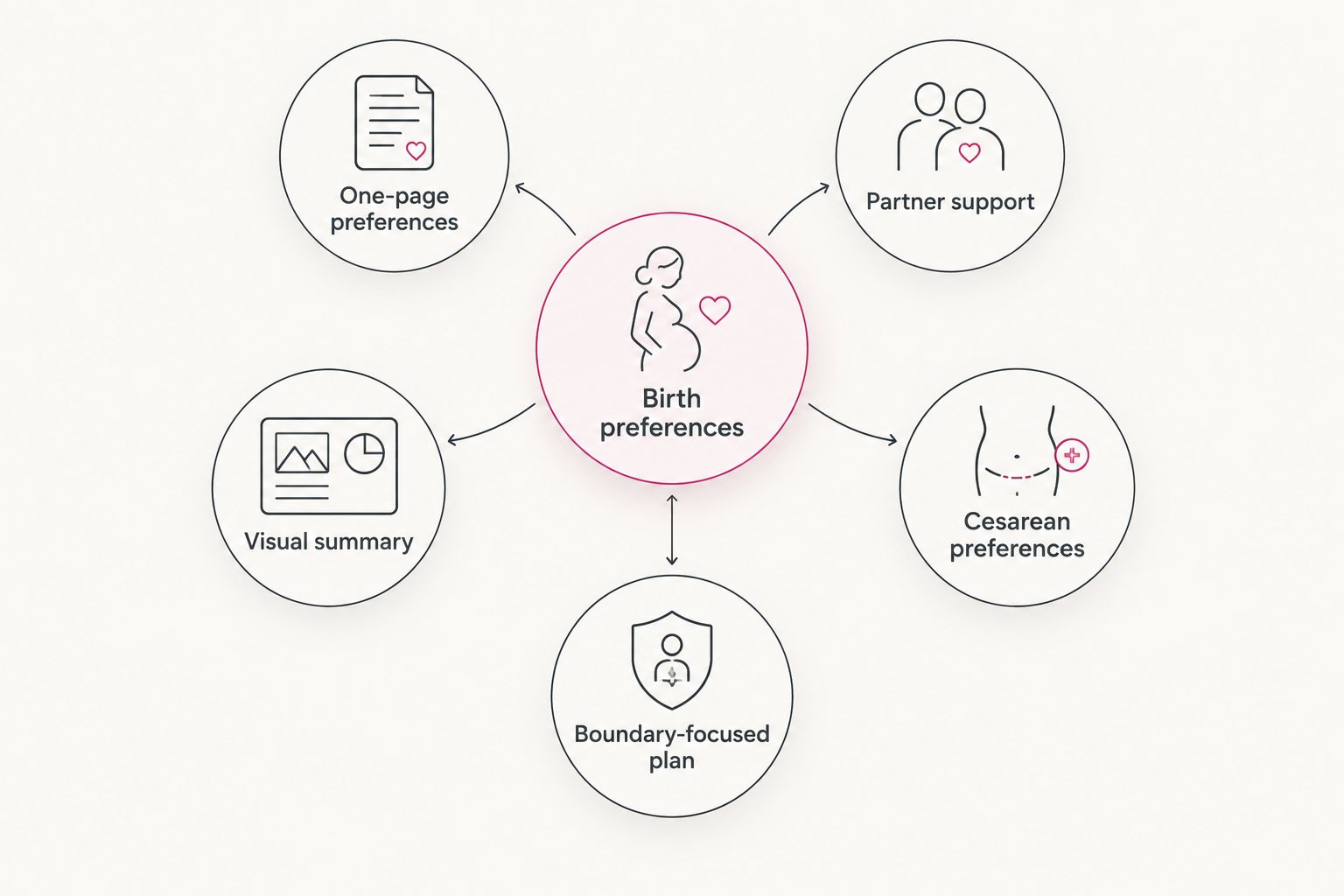
Best overall: a one-page preferences template. Best for shared support: a partner-and-doula template. Best for quick reading: a visual birth plan. These are the best birth plan templates for hypnobirthing when you want to communicate your wishes without turning birth into a script; Hypnotherapy Mind offers hypnobirthing and birth doula services for women preparing for birth.
- The best birth plan templates for hypnobirthing start with a one-page summary of your preferences.
- Choose a partner-and-doula template when your support team needs clear roles.
- Use a cesarean preferences template to discuss surgical birth with your care team.
- Hypnotherapy Mind supports women seeking hypnobirthing preparation and birth doula services.
- A birth plan communicates preferences; it does not guarantee an outcome or replace medical advice.
Why this matters
A hypnobirthing birth plan should explain what helps you feel calm, informed, and involved. It should also make room for your preferences to change. You do not lose your preparation when you request pain relief, need an intervention, or give birth differently from what you imagined.
For your 2026 birth preparation, choose a format that your care team can read quickly and discuss with you beforehand. A beautiful document is less useful than a clear conversation about your wishes, the setting, and the care available to you.
Hypnotherapy Mind is a fit for women seeking hypnobirthing preparation and birth doula support. The template itself serves a different purpose: it puts your preferences into words that your partner, doula, and clinical team can understand.
What makes the best hypnobirthing birth plan template?
Judge a template by what it helps you communicate, not by how closely it resembles someone else's birth story.
- Readable priorities: Put your most important preferences at the top, rather than burying them in a long checklist.
- Hypnobirthing cues: Include your preferred breathing reminders, relaxation recordings, environment, and language.
- Consent and communication: Explain how you want examinations, recommendations, and changes in care discussed.
- Support roles: State what your partner or doula can do without speaking over you.
- Adaptability: Leave room for pain relief, a change of setting, or a cesarean discussion without framing these as failure.
- Personal boundaries: Include touch, privacy, and language preferences without requiring you to disclose private experiences.
Start with 3 priorities you want people to remember. That is an editing recommendation, not a medical rule. Everything else should clarify those priorities or address a genuinely important preference.
Birth plan templates at a glance
These are document formats, not named downloads or commercial products. Each format below serves a different purpose, so you can choose one main template and add only what you need.
| Template format | Best for | Standout feature | Key limitation |
|---|---|---|---|
| One-page preferences | A clear default plan | Keeps essential wishes together | Leaves little room for detailed support instructions |
| Partner support | Coordinating your partner and doula | Assigns practical support roles | Needs a separate clinical summary |
| Visual summary | Making priorities easy to scan | Uses short labels with plain-language explanations | Icons alone can be misunderstood |
| Cesarean preferences | Preparing for a surgical-birth conversation | Separates surgical and recovery wishes | Every request needs discussion with the clinical team |
| Boundary-focused plan | Communicating privacy and touch preferences | States boundaries without requiring personal history | Does not replace individualized trauma support |
The formats can work together, but avoid handing your team several documents that contradict each other. Keep one main summary, then give your support person any additional notes intended specifically for them.
1. One-page preferences: best for a clear hypnobirthing plan
A one-page preferences template is the strongest default because it asks you to decide what matters most. You can include the atmosphere you prefer, how you use hypnobirthing techniques, and how you want your team to communicate.
Aim for 1 page as a practical editing target. If your medical history needs more explanation, discuss that separately with your clinician rather than shrinking the text until nobody can read it.
What to put in your template
Use these headings as a starting point:
- My priorities: What helps me feel informed, respected, and supported.
- My environment: Preferences for lighting, sound, privacy, and interruptions, where possible.
- My hypnobirthing tools: Breathing cues, recordings, relaxation reminders, or supportive words.
- Communication: How I would like recommendations and examinations explained.
- Changes in care: What I want discussed if my preferences need to change.
- After birth: Questions and preferences to review with the team caring for me and my baby.
For example, you can write that you prefer a calm explanation before an examination and want your support person to remind you of your chosen breathing practice. These are requests to discuss, not promises about how birth will unfold.
One-page preferences pros:
- Gives your team a clear starting point.
- Keeps hypnobirthing cues visible.
- Makes revisions manageable.
One-page preferences cons:
- Cannot hold every detail of your preparation.
- Becomes hard to read if you fill every space.
Best for: You want one main document for your 2026 birth preparation.
Verdict: Choose the one-page preferences template as your default.
2. Partner support: best for coordinating your birth companions
A partner-and-doula template describes what support looks like to you. It separates emotional and practical help from clinical decisions, which belong in conversations with your medical team.
Your companion does not need a script for every contraction. They need to know which reminders you welcome, when you prefer quiet, and how to help you ask questions.
What to put in your template
Organize the support notes around these prompts:
- When I feel settled: Ask before interrupting my relaxation or changing the room environment.
- When I feel overwhelmed: Offer the grounding cue I chose during preparation.
- When care changes: Help me hear the explanation and ask my questions.
- When someone needs information: Help locate my preferences while leaving space for me to speak.
Agree on these roles before birth. A support person should not assume that a technique you enjoyed during practice will feel right during labor.
Partner support pros:
- Turns general encouragement into specific actions.
- Helps companions understand their roles.
- Protects your right to change your preferences.
Partner support cons:
- Does not replace a clinical birth preferences summary.
- Needs a conversation, not just a document handed over at the last moment.
Best for: You want your partner and doula to support you consistently without speaking for you.
Verdict: Choose the partner support template as a companion to your main plan.
3. Visual summary: best for making your priorities easy to scan
A visual birth plan uses short headings, spacing, and simple symbols to organize preferences. Its strength is readability, not decoration. Every symbol needs a written explanation so your team does not have to guess what you mean.
For a visual plan prepared in 2026, keep your essential requests in plain language. A symbol suggesting quiet, for example, does not explain whether you want fewer conversations, no music, or spoken relaxation cues.
What to put in your template
Use brief labels such as Calm environment, Explain first, Support person, and Ask about touch. Beneath each label, write the specific request you want to discuss.
Keep your name and the current version easy to find. Avoid using color as the only way to communicate meaning, since someone reading a printed copy still needs to understand every preference.
Visual summary pros:
- Makes key requests easy to locate.
- Encourages concise wording.
- Helps separate topics without long paragraphs.
Visual summary cons:
- Unexplained icons create ambiguity.
- Attractive formatting can hide missing information.
Best for: You already know your priorities and want a readable summary rather than a detailed worksheet.
Verdict: Choose a visual summary only when the written requests remain clear without the graphics.
4. Cesarean preferences: best for discussing surgical birth
A cesarean preferences template helps you ask about communication, support, and recovery if surgical birth is planned or becomes part of your care. It is not a set of instructions for the operating room.
Hypnobirthing preparation does not have to disappear from this conversation. You can discuss whether your breathing cues, relaxation practice, or preferred supportive language can remain part of the experience.
What to put in your template
Bring questions rather than assumed arrangements:
- Communication: How will the team explain what is happening?
- Support: Who can be present, and under what circumstances?
- Relaxation: Which comfort or listening preferences can be accommodated?
- Meeting my baby: What options can be discussed, depending on my baby's and my condition?
- Recovery: How will comfort, support, and feeding questions be addressed?
Review your 2026 cesarean preferences with your clinical team before birth when possible. The setting, your circumstances, and your baby's needs affect which requests can be accommodated.
Cesarean preferences pros:
- Gives you a starting point for a surgical-birth discussion.
- Keeps communication and emotional support visible.
- Makes room for preparation without requiring certainty.
Cesarean preferences cons:
- Cannot predict clinical circumstances.
- Requests depend on the care setting and medical assessment.
Best for: You want to discuss surgical birth without treating it as the opposite of a supported birth.
Verdict: Choose cesarean preferences as a discussion guide, not a guaranteed sequence.
5. Boundary-focused plan: best for privacy and touch preferences
A boundary-focused template puts consent, privacy, and communication needs at the center. You can use it after a difficult experience or simply because these preferences matter to you.
You do not need to include a personal history to explain a boundary. The useful information is what you want someone to do, ask, or explain now.
What to put in your template
Consider these prompts:
- Touch: Please explain and ask before touching me or beginning an examination.
- Privacy: Please discuss who needs to be present.
- Language: These words feel supportive; these words do not.
- Distress: This is how I would like my support person to help me communicate.
- Discussion: Please speak directly to me and explain recommendations clearly.
Bring these preferences into a prenatal conversation so your clinician can discuss how they apply in your care setting. A template is a communication aid, not treatment for birth trauma or a substitute for mental health care.
Boundary-focused plan pros:
- Makes personal boundaries explicit.
- Avoids requiring disclosure of private experiences.
- Gives support people practical guidance.
Boundary-focused plan cons:
- Cannot ensure every interaction will feel comfortable.
- Needs discussion when preferences affect examinations or urgent care.
Best for: You want your privacy, touch, and communication preferences clearly recorded.
Verdict: Choose a boundary-focused plan when those needs deserve more space than a standard checklist provides.
How these templates are ranked
The ranking prioritizes readability, clear requests, support roles, and flexibility. The one-page preferences template comes first because it provides a main summary; the other formats address distinct needs rather than competing for the same role.
No format earns a recommendation for promising a particular birth outcome. A useful template supports communication even when your preferences change.
Which birth plan template should you choose?
Start with a one-page preferences template, then add only the notes you need. Add partner support instructions for your companions, cesarean questions for your clinician, or a boundary-focused section for personal needs.
Before you finalize your 2026 plan, ask your care team to discuss unclear requests. Prepare 2 copies as a practical backup: one for your birth bag and one for your support person. Keep both consistent with your current wishes.
If you want support with hypnobirthing preparation, Hypnotherapy Mind provides hypnobirthing and birth doula services. Your maternity team remains the source for individualized medical advice and decisions about clinical care.
FAQ
What's the best birth plan template for hypnobirthing?
A one-page preferences template is the best default for hypnobirthing because it keeps your key wishes readable. Include relaxation cues, communication preferences, support roles, and questions about changes in care.
Should I use a visual birth plan or a written birth plan?
Choose a written plan unless a visual layout makes your preferences easier to read. A visual plan still needs plain-language explanations; symbols should never carry the meaning alone.
Can I use hypnobirthing if I choose pain relief?
You can include hypnobirthing relaxation and breathing preferences alongside a request to discuss pain relief. Ask your maternity team how your chosen methods fit with your individual care.
What should my partner's birth plan include?
Your partner's support notes should explain the reminders, practical help, and communication support you welcome. Include an explicit instruction to support your current wishes if they change during birth.
Do I need a birth plan for a planned cesarean?
A birth plan is optional, but a cesarean preferences document can organize your questions about communication, support, meeting your baby, and recovery. Discuss each request with your clinical team rather than assuming it can be accommodated.
Can Hypnotherapy Mind help with birth preparation?
Hypnotherapy Mind provides hypnobirthing and birth doula services for pregnant women. Discuss your preparation needs with Candice Enriquez and review medical questions with your maternity clinician.
Does a hypnobirthing birth plan guarantee a calm birth?
No birth plan guarantees a calm birth or a particular outcome. Its purpose is to communicate your preferences and support discussion, including when circumstances or your wishes change.