
Yes—hypnotherapy can support practical labor preparation for fear of needles through relaxation, focused attention, and rehearsed coping responses. Childbirth education with HypnoBirthing places these skills within preparation for the whole birth experience. You can practice familiar calming cues, share your preferences, and plan how you want to feel supported.
- Can hypnotherapy help with fear of needles during labor? Yes—practice relaxation, focused attention, and supportive communication.
- Hypnotherapymind offers hypnotherapy and HypnoBirthing; individual preparation and broader birth preparation serve different needs.
- Share your needle concerns and comfort preferences with your birth team before labor.
- Choose breathing, communication, and support preferences that still work when your birth plan changes.
Can hypnotherapy help with fear of needles during labor?
Hypnotherapy helps you prepare for an epidural through focused attention and practiced coping responses. It uses focused attention and suggestion to help you rehearse a different response to something you find distressing. You remain involved; hypnosis is not the same as being unconscious.
The useful question is what you want to practice. Perhaps you want to stop watching equipment, ask for a pause without apologizing, or return your attention to your breathing when anticipation builds.
At Hypnotherapymind, I offer hypnotherapy alongside HypnoBirthing and birth doula services. These are different forms of support, and choosing between them starts with the experience you want help preparing for.
| Approach | Best for | What it offers | Limitation |
|---|---|---|---|
| Individual hypnotherapy | Focused preparation around a specific fear | Guided attention, relaxation, and rehearsal of coping responses | Requires practice and a plan tailored to your needs |
| HypnoBirthing | Broader emotional preparation for childbirth | Breathing, relaxation, and birth-focused practice | Does not replace individualized treatment for a significant phobia |
| A procedural support plan | Communicating needs during an epidural | Clear preferences for explanations, positioning, and support | Does not itself treat the underlying fear |
These approaches do not need to compete. You can prepare emotionally and still ask your care team for practical adjustments.
Why this matters: feeling frightened is not failing
Needle fear can occupy more of your attention than the procedure itself. You might feel comfortable imagining waves yet become tense at the thought of an IV, blood draw, or an epidural needle. That difference deserves understanding, not judgment.
For your birth preparation, make room for the part that actually worries you. A beautiful birth plan is less useful if it leaves your biggest concern unspoken.
You do not need to become a person who likes needles. A more meaningful goal is to recognize your response, communicate what helps, and have something familiar to return to when you feel unsettled.
Joy and apprehension can exist together. Preparing for a difficult moment does not take away from the meaning of meeting your baby; it gives that moment some thoughtful attention before labor begins.
Individual hypnotherapy: focused preparation for needle fear
Hypnotherapy brings attention to the relationship between what you imagine, what you feel, and how your body responds. For needle fear, preparation can include noticing an anxious thought and rehearsing a response that does not require arguing with yourself.
That response might be looking toward your partner, listening to a familiar phrase, or remembering that you can ask a question. The goal is not to convince yourself that a procedure is pleasant. It is to build a response you can recognize and use.
An imagined rehearsal should feel collaborative. You can discuss what you are comfortable exploring, what you do not want described, and how you will signal that you want to stop. There is no need to make the imagined scene vivid simply to prove you can tolerate it.
Hypnotherapymind is best suited to people seeking practitioner-led hypnotherapy or birth preparation with a focus on personal coping skills and support.
Childbirth education with HypnoBirthing: practical labor preparation
Childbirth education with HypnoBirthing brings breathing, relaxation, and guided hypnosis into your labor preparation. You can explore needle concerns alongside your wishes for the whole birth experience, including how your partner or doula can support you. In my Tampa practice, I welcome conversations about what helps you feel comfortable, connected, and heard.
Best for broader birth preparation: HypnoBirthing makes sense when you want to work on anticipation, confidence, and your experience of birth as a whole. A particular needle fear can still deserve its own focused conversation.
Your HypnoBirthing practice does not need to depend on a particular delivery setting or an unchanged plan. Choose cues you can carry with you: familiar words, a breathing rhythm that feels comfortable, or your support person's voice.
Calm is not the only acceptable emotion. You can feel strong sensations, ask for pain relief, change your mind, or need reassurance without having done the practice incorrectly. Mother-directed preparation leaves room for your choices rather than turning a preferred birth experience into a test.
Why your response to needle preparation varies
The most useful starting point is the part of the experience that feels difficult. Consider these factors when discussing preparation:
- Anticipation: Is waiting for the procedure harder than the brief procedure itself? Practice what you will do while you wait.
- Visual triggers: Does seeing equipment increase distress? Ask whether equipment can remain outside your view.
- Past experiences: Was a previous procedure upsetting? Explain which part you do not want repeated, without feeling obliged to recount every detail.
- Communication preferences: Do explanations reassure you, or does detailed narration make you more tense? State your preference clearly.
- Physical comfort: What position or support helps you feel comfortable? Discuss your preferences with your clinical team beforehand.
These questions are more useful than labeling yourself as bad with needles. They turn a broad fear into specific information that your support people can understand.
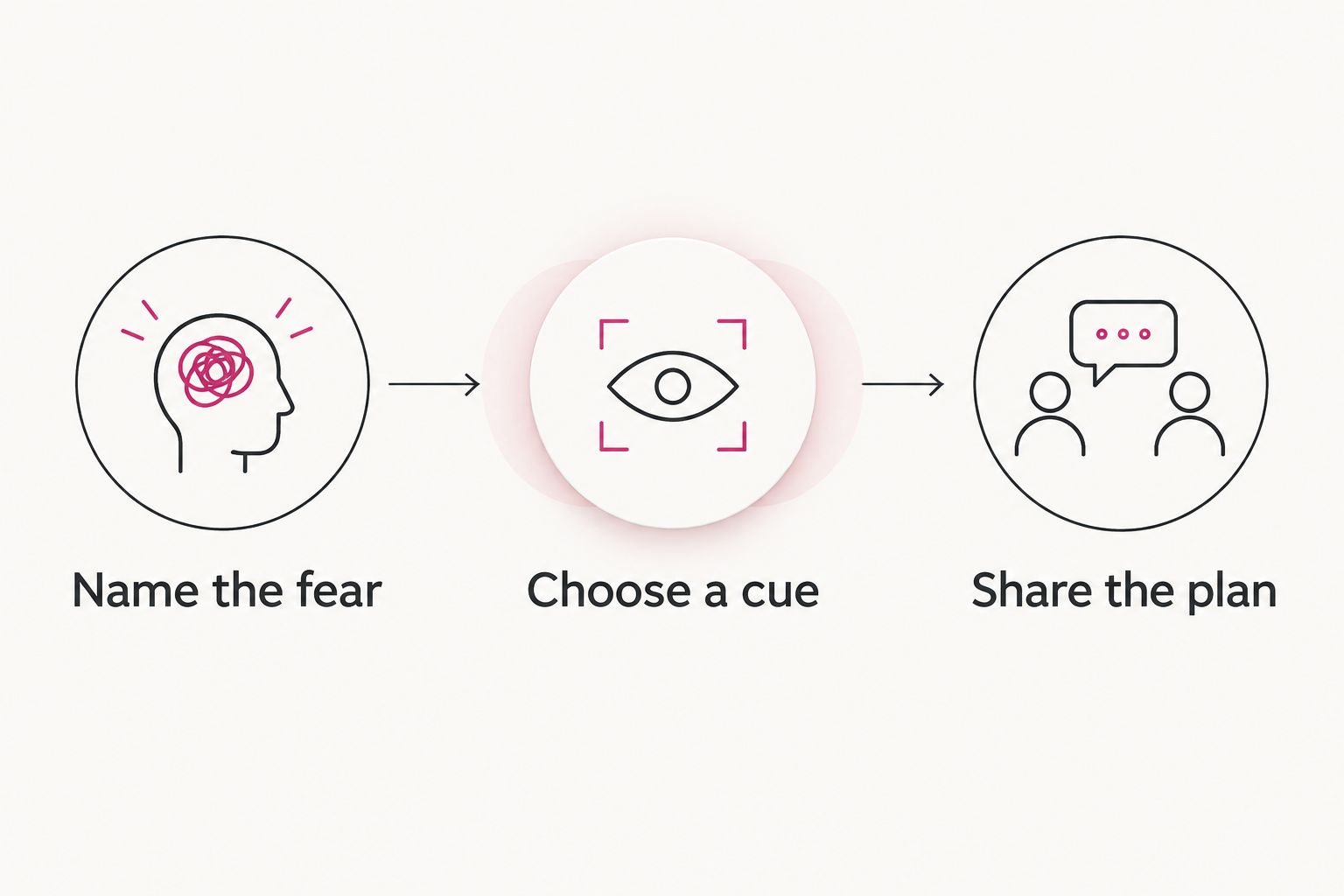
Practical labor preparation: build a 3-part plan
Practical labor preparation joins familiar coping skills with clear requests for your birth team. Use the steps below to turn your hypnotherapy or HypnoBirthing practice into a short plan you and your support person can remember during labor.
Name the fear
Write 1 sentence describing the part you find hardest. For example: I become frightened when I see the needle, and I want to look away before equipment is prepared.
That example is a planning prompt, not a birth story or a script you must copy. Your concern might instead be discomfort, feeling trapped, an unexpected touch, or not knowing what will happen next.
Be specific without forcing yourself to dwell on distressing details. Naming the trigger helps you choose a relevant response; repeatedly imagining the worst does not need to be part of your preparation.
Choose a cue
Choose a simple action that feels comfortable during ordinary practice. You might soften your jaw, notice your feet resting against the floor, or turn your attention toward a familiar voice.
Use breathing gently rather than trying to perform it perfectly. You do not need to force large breaths, hold your breath, or follow a demanding count to make the practice meaningful.
If you use guided hypnosis, discuss how its suggestions connect to the real situation. A cue is more useful when it reminds you of something you have practiced than when it introduces unfamiliar instructions at a stressful moment.
Share the plan
Choose 2 preferences you most want your support person and care team to know. Examples include keeping equipment out of view and explaining a step before touching you.
If you want help speaking up, agree on the words your support person can use. Your partner or doula can remind the team of your preferences while leaving decisions with you.
For your birth plan, write these requests alongside the concern they address. A short explanation helps others understand why a seemingly small detail matters to your sense of comfort.
Practice should leave room for adjustment. If a phrase feels irritating, change it; if silence feels better than an audio recording, say so. The aim is a familiar, usable response—not a perfect relaxation routine.
What can I ask for when I choose an epidural?
You can tell the person caring for you that you are frightened and explain what usually helps. Ask what choices are possible before the procedure begins, recognizing that circumstances affect what the team can accommodate.
Useful requests include:
- Explain the next step before starting, without describing every technical detail.
- Keep equipment outside my line of sight when possible.
- Let my support person stay close when permitted.
- Give me a moment to settle into an appropriate position.
- Tell me who to speak to when I need extra support.
If you have a history of fainting around needles, tell your clinical team beforehand so they can plan appropriate positioning and support.
You are allowed to use hypnotherapy preparation and request other comfort measures. Neither choice cancels the other.
Do I have to start hypnotherapy early in pregnancy?
You do not need a universal start date to begin discussing needle fear. Starting before labor gives you an opportunity to identify triggers, discuss suitable support, and become familiar with your chosen practice.
For your birth, discuss a preparation plan that fits your circumstances, the concerns you want to address, and the time you have to practice between sessions.
If your due date is close, prioritize communication. Sharing a clear concern with your birth team is still useful even when you have had little time for structured practice.
Can I use hypnotherapy if I want an epidural?
Yes—hypnotherapy preparation can sit alongside a preference for an epidural. Working with needle fear does not require choosing an unmedicated birth or proving that you can manage without pain relief.
Discuss the procedure itself with your maternity or anesthesia team, then use your preparation to support the parts you can influence: where you direct your attention, how you communicate, and who helps you feel grounded.
Your preferences can change during labor. Preparation that respects your choices remains relevant when the plan changes.
Is hypnotherapy only useful for childbirth concerns?
No—hypnotherapy is not limited to childbirth preparation. At Hypnotherapymind, I also offer hypnotherapy for people seeking personal transformation or support with birth trauma healing.
If birth preparation brings up a concern that feels larger than the upcoming delivery, you do not have to squeeze it into a breathing exercise. A conversation can help distinguish what you want from birth preparation and what deserves separate support.
Start with the changes you want to practice and the support that feels right for you. The starting point is your experience, your preferences, and the kind of help you want—not an expectation that you should already feel calm.
Explore support that starts with you
Learn about Candice Enriquez's hypnotherapy, HypnoBirthing, and birth doula services.
FAQ
How can I prepare for an epidural before labor?
Practice a familiar coping cue, such as comfortable breathing or focusing on your support person's voice. Share your preferences with your birth team, including whether you want equipment kept out of view and explanations before each step.
Will I be unconscious or lose control during hypnosis?
Hypnosis is not unconsciousness, and you can communicate or stop the exercise. Discuss your preferences and boundaries with the practitioner before beginning.
Is hypnotherapy the same as HypnoBirthing?
Individual hypnotherapy can focus on a specific concern, such as needle fear. Childbirth education with HypnoBirthing supports broader labor preparation through breathing, relaxation, and birth-focused practice.
Can I practice breathing if I still feel scared?
Yes—you can practice comfortable breathing while still feeling scared. The goal is to give your attention somewhere supportive to return, not to demand that every anxious feeling stops.
Can my partner or doula help me with needle fear?
Your partner or doula can remind you of a practiced cue and help communicate your stated preferences. Agree beforehand on what feels reassuring and what you would rather they avoid.
Does asking for an epidural mean HypnoBirthing has failed?
No—choosing an epidural does not mean your preparation has failed. Breathing, relaxation, and communication remain relevant when you choose pain relief or change your birth plan.
Does Hypnotherapymind offer hypnotherapy outside pregnancy?
Yes—Hypnotherapymind offers hypnotherapy beyond childbirth preparation, including support for people seeking personal transformation. Candice Enriquez also provides HypnoBirthing and birth doula services.
A confident step toward birth
Practice a calming cue, share what helps, and welcome support. Your choices matter, and you deserve to feel heard, encouraged, and supported as you prepare to meet your baby.